Introduction
Flower field portraits have become one of the most loved aesthetics in AI-generated photography, capturing the soft romance of golden light, blooming petals, and dreamy natural backdrops. Inspired by cinematic movies, editorial fashion shoots, and golden-hour photography, this trend transforms an ordinary photo into a breathtaking portrait that feels like a still frame from a film.
The "Cinematic Flower Field Portrait Prompt" combines warm natural lighting, vibrant or pastel flower fields, flowing fabric, and soft depth of field to create an emotional, storybook-like image. Instead of a plain studio photo, the subject appears surrounded by nature — wildflowers, tall grass, or lavender fields — bathed in the gentle glow of sunrise or sunset.
This style draws from romantic film photography, Pinterest-inspired portraiture, and fashion editorials that use natural landscapes as a backdrop. The goal is to blend realism with cinematic emotion, giving the impression of a candid yet artistically composed moment.
With AI tools, anyone can achieve this look without needing an actual flower field, professional camera equipment, or a golden-hour photoshoot. A single reference photo and a well-crafted prompt are enough to generate a polished, cinematic result.
"Cinematic Flower Field Portrait Prompt"
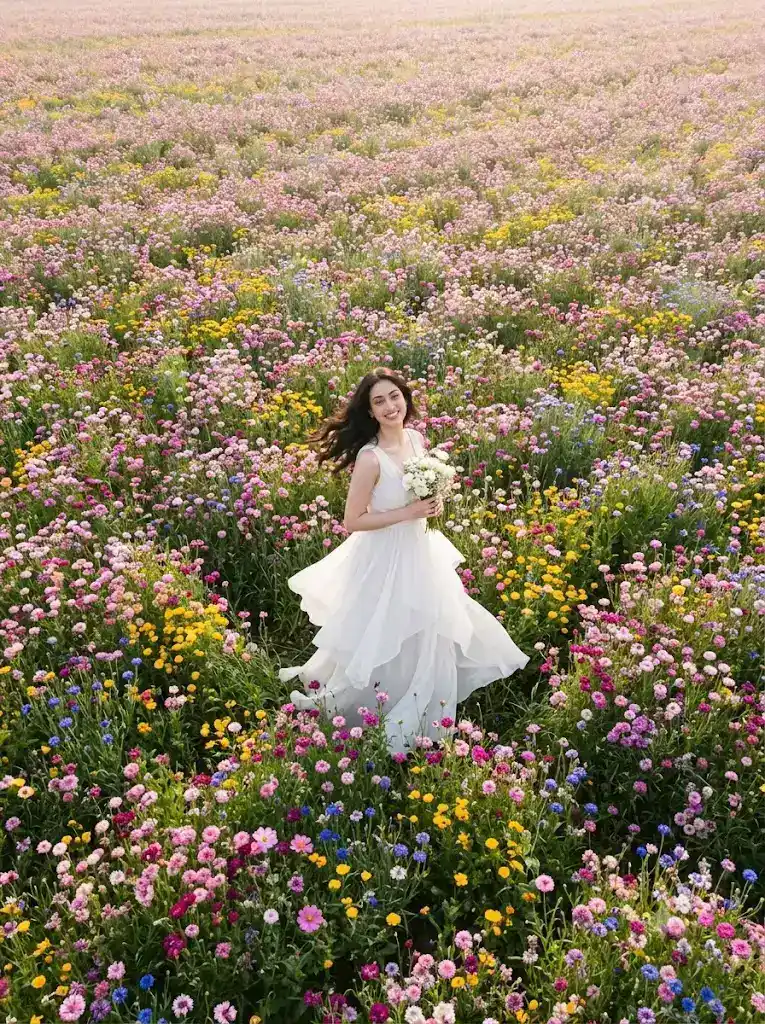
A cinematic, slightly elevated aerial view of a woman standing gracefully in the middle of a vast field of densely packed flowers, stretching endlessly in every direction. The flowers form a rich, continuous pattern across the landscape, creating a sense of scale and immersion. The woman appears small within the frame, emphasizing the vastness around her. She faces the camera with a warm, joyful smile, standing in a stylish, elegant pose. She wears a flowing white dress with soft, layered fabric that moves gently, adding a dreamy and romantic feel. Her hair is long and softly styled, complementing the natural elegance of the scene. The lighting is soft and natural, evenly illuminating both the subject and the surrounding flowers. The overall mood is dreamy, serene, and cinematic, with fine-art photography aesthetics, high detail, gentle color harmony, and a poetic, uplifting tone. 3:4 ratio size image.
How To Use Photo Editing?
Unlike traditional photo-editing applications that mainly adjust brightness, colors, or filters, the Cinematic Flower Field Portrait trend uses AI image-generation and editing technology to create an entirely new environment around the subject.
The AI follows the instructions in your prompt and can generate details such as the endless flower field, flowing dress, aerial perspective, natural lighting, and cinematic atmosphere.
Here’s the typical workflow:
1. Upload a clear reference photo
Choose a high-quality photograph with a clearly visible face and natural appearance. A clean reference image generally helps the AI understand the subject more accurately.
2. Copy or create a detailed prompt
Describe the flower field, clothing, camera perspective, lighting, colors, pose, and overall mood.
3. Generate the image
The AI combines your reference image with the prompt and creates the cinematic flower-field composition.
4. Compare multiple versions
Generate several variations and check the subject’s appearance, flower density, composition, dress details, lighting, and overall realism.
5. Refine the result
Use follow-up instructions to make specific adjustments. For example, you can ask for a wider flower field, softer lighting, more natural flowers, or a higher camera angle.
Detailed prompts generally provide better control. Instead of simply saying “put me in a flower field,” describe the field as “an endless densely packed floral landscape viewed from a slightly elevated aerial perspective with soft natural light and dreamy fine-art photography.”
Tools You Can Use For Prompt Copy and Create Photo
Several AI platforms can help you create a Cinematic Flower Field Portrait.
1. Midjourney
Midjourney is useful for creating cinematic landscapes, detailed flowers, atmospheric environments, and fine-art compositions. It can be a good choice when you want a visually rich flower field.
2. Leonardo AI
Leonardo AI provides image-generation and editing features that can help you experiment with different landscapes, floral colors, clothing styles, camera perspectives, and lighting conditions.
3. Google Gemini
Gemini-based image tools can offer a straightforward natural-language workflow for image creation and editing, depending on the features available to the user.
4. Canva AI
Canva is useful when you want to combine AI image generation with traditional editing. After generating the image, you can adjust cropping, brightness, contrast, filters, and other design elements.
5. ChatGPT With Image Generation
ChatGPT can help you create detailed image prompts and refine them according to your desired composition. Where image-generation capabilities are available, you can also use reference images and make adjustments through follow-up instructions.
Many creators begin with a ready-made Cinematic Flower Field Portrait Prompt and customize details such as flower colors, dress style, location, lighting, camera height, and overall mood.
How To Edit Photo?
Creating your own cinematic flower-field portrait is simple when you follow a structured workflow.
Step 1: Choose a strong reference photo
Select a clear, high-resolution photograph with natural facial details. Avoid extremely blurry images or photographs with heavy filters.
Step 2: Copy the flower field prompt
Paste the detailed prompt into your selected AI image-generation or editing tool. Customize the clothing, flower colors, and environment if required.
Step 3: Set the camera perspective
The aerial or slightly elevated perspective is an important part of this concept. It makes the woman appear smaller and emphasizes the enormous flower field surrounding her.
Step 4: Describe the flowers
You can specify different types and colors of flowers according to your preference. For example, you can request pastel flowers, wildflowers, roses, sunflowers, or a mixed floral landscape.
Step 5: Add cinematic lighting
Use phrases such as “soft natural light,” “diffused sunlight,” “gentle highlights,” “warm golden-hour atmosphere,” and “subtle cinematic haze” to create a beautiful visual mood.
Step 6: Generate multiple variations
Create several versions and compare the subject’s appearance, dress movement, flower density, camera angle, and overall composition.
Step 7: Request targeted refinements
If the flowers look repetitive, ask for “more natural variation in flower sizes and colors.” If the subject appears too large, request a “wider aerial composition with the woman appearing smaller within the landscape.”
Step 8: Apply final adjustments
After selecting your favorite result, use an editing application to make subtle adjustments to brightness, contrast, highlights, shadows, sharpness, and cropping. For a cinematic appearance, a small amount of film grain can also be added.
Conclusion
The Cinematic Flower Field Portrait Prompt offers a beautiful way to merge natural beauty with emotional, film-like storytelling. By combining golden-hour lighting, blooming flowers, flowing fabric, and soft cinematic tones, this style turns a simple photo into a breathtaking visual moment.
The key to success lies in choosing a clear reference image and writing a detailed, descriptive prompt covering lighting, setting, and styling. Whether for social media, a profile picture, or personal creative art, this prompt allows anyone to create a dreamy, cinematic portrait that feels straight out of a romantic film.